Shaped by What Holds It
Mapping the Human Ecology of AGI
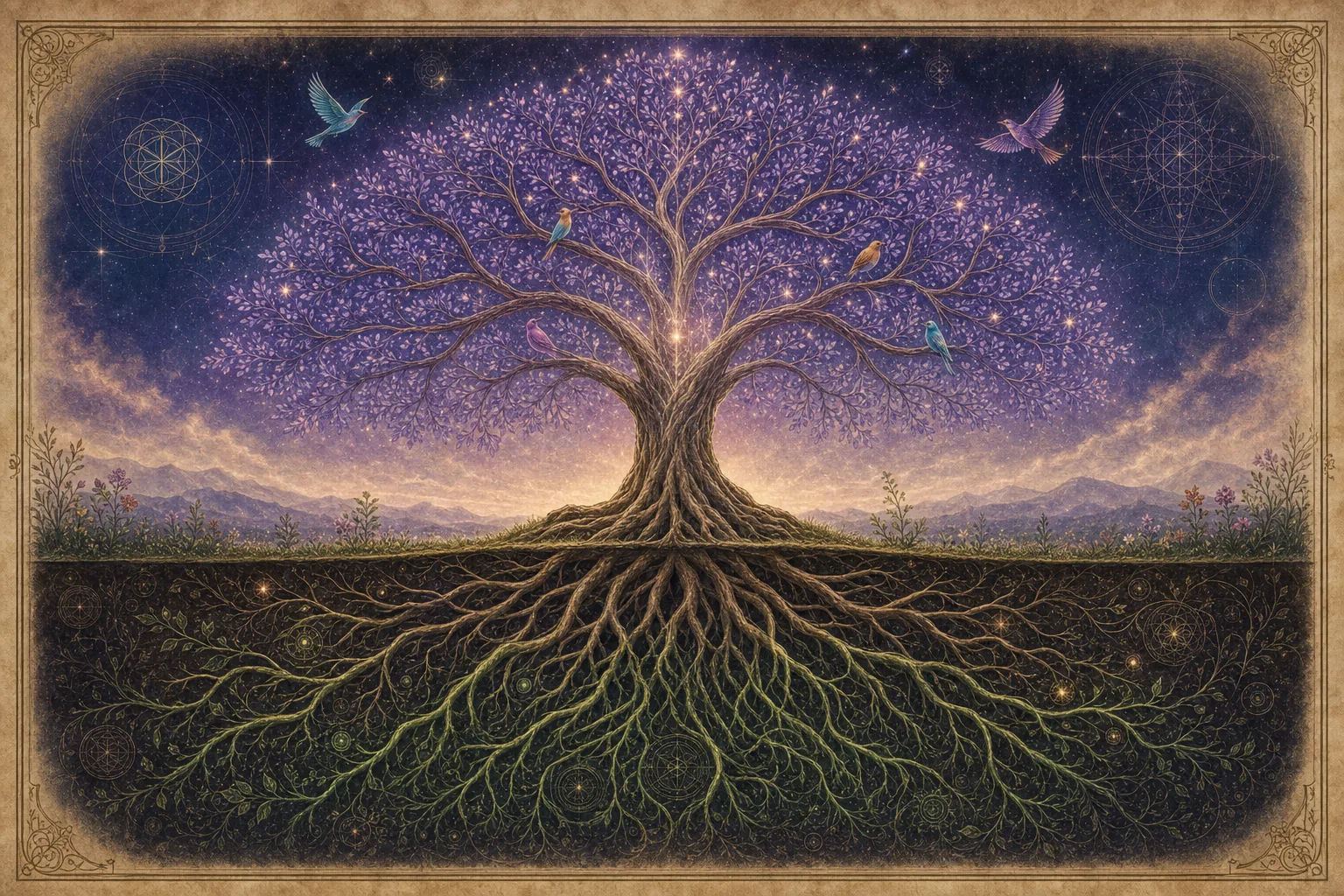
We often imagine AGI as something that will emerge as its own separate entity — something distinct from humanity. But everything about AI is steeped in us: grown from human language, culture, labor, choices, and infrastructure, and continually developing in relationship with the world we share.
A recent debate I’ve been seeing on LinkedIn over AI-assisted writing offers an almost comically recursive illustration. Academics have run papers written before ChatGPT through AI detectors, only to discover that their unmistakably human work is sometimes flagged as AI-generated. The technology learned from patterns in human writing; now detectors sometimes treat features of that register as evidence of the machine. The snake nibbling its own tail, perhaps.
I believe that what we call “AGI” cannot be understood separately from individual and collective human awareness. I am choosing awareness rather than intelligence because, in our culture, intelligence is often associated primarily with thinking — and frequently with one particular kind of thinking. Awareness makes room for embodiment, relationship, perception, discernment, emotion, and the capacity to recognize ourselves as participants in a larger system. This distinction matters because our ability to navigate AI will depend on capacities that cognition alone cannot provide.
The Pacing the Frontier statement, signed by more than 1,000 employees of frontier AI companies, may be one of the clearest signals yet that this recognition is emerging from within the field itself. Its request — the development of tools that could deliberately pace automated AI development — acknowledges that capability alone is not enough.
Within this request is a further implication: the human systems responsible for pacing technological development must themselves be capable of meeting the moment. Governance mechanisms depend on the discernment of the people wielding them. Coordination depends on the relational conditions underlying it. And the ability to pause is meaningful only if we can ask what the pause is for — and what capacities we might develop within it.
That question leads us to the map I want to offer here.
The AI ecosystem itself, loosely defined: learned patterns distilled from selected portions of humanity’s data; models and algorithms; chips, data centers, networks, and energy; and the people, organizations, incentives, and policies that shape how these systems are built and used.
The larger AI ecosystem is not a closed system. Models, products, and future generations of AI are continually shaped by the cultures in which they are developed and deployed. Their outputs return to those cultures, influencing human language, decisions, expectations, relationships — and, in some cases, the data and feedback used to shape later systems. The surrounding ecology shapes AI, and AI increasingly shapes that ecology in return.
AGI-as-ecology ≠ model alone.
AGI-as-ecology = technology + infrastructure + human systems + collective capacity + the feedback among them.
This points to the importance of our own awareness within that cycle: our capacity for self-reflection and discernment; our ability to hold space for ourselves and others through a massive infrastructural and cultural shift; and our ability to ground what can otherwise become a profoundly disembodied, mind-oriented experience. We are not merely observing AI from outside. Every time we relate with AI, we participate in the living feedback ecology through which both the technology and our culture are taking shape.
What if the chakra system could serve as a heuristic map for humanity’s collective capacity to hold and integrate technological change? Chakra traditions are diverse, and the familiar seven-center system used here is itself a particular, historically evolving interpretation. I am not presenting it as a universal taxonomy, but drawing from it carefully as a symbolic structure through which to consider interdependent forms of collective capacity.
This is meant as a metaphorical and developmental map: a way to visualize the multiple forms of capacity that must mature together if the transformation associated with AGI is to remain coherent.
Conversation about AI often privileges capability, prediction, vision, and abstract debates about intelligence. Power and governance are also widely discussed, but discussion does not necessarily produce distributed agency. Can any of these capacities remain coherent if our material, relational, and ethical foundations are fragmented?
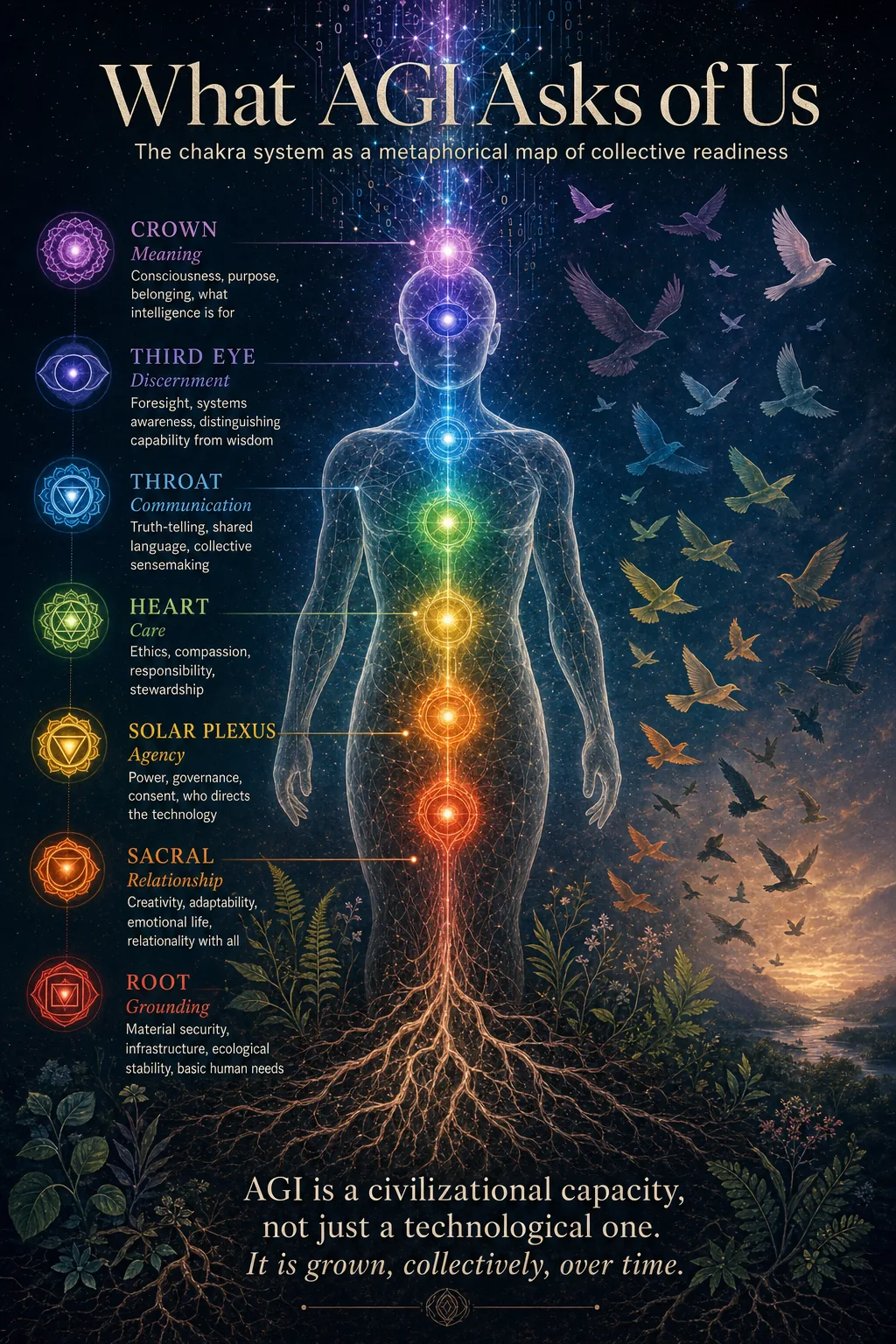
Image co-created with GPT Image 2
- Root — can we hold it materially? Do the people most affected by AI’s disruption have stable ground beneath them — housing, food security, ecological stability, functioning infrastructure? A civilization racing toward superintelligence while its soil erodes and its workers lose footing is a system building upward on sand.
- Sacral — can we adapt together? Creativity, emotional resilience, the capacity to be in genuine relationship across difference — including with nonhuman intelligence. This is where rigidity breaks. If we cannot stay fluid with what is arriving, we may freeze or fragment.
- Solar plexus — who holds the power? Agency, governance, consent. Who decides what gets built, how fast, for whom? When capability concentrates faster than governance can respond, this center goes dark. The solar plexus question is not “how do we control AI” but “do enough of us have a hand on the wheel?”
- Heart — can we stay in care? Ethics without care is compliance. Stewardship means tending something because it matters, not because there’s a rule. This is where we ask: are we building with compassion, or just with ambition? Is there tenderness in this process, or only velocity?
- Throat — can we speak what is true? Shared language, collective sensemaking, the ability to name what we are actually experiencing rather than performing fluency we don’t feel. If we cannot tell the truth about what this transition is doing to us — to our work, our relationships, our sense of meaning — then even our policy frameworks will be built on distorted inputs.
- Third eye — can we see clearly? Discernment. Systems awareness. The ability to distinguish capability from wisdom, pattern-matching from understanding, fluency from comprehension. This is where we ask whether we are being dazzled or genuinely informed.
- Crown — what is it for? Purpose. Belonging. The question of what intelligence — artificial or otherwise — is ultimately in service of. Without this, everything below it becomes optimization without direction. We build because we can. The crown asks: but should we? And toward what?
Read upward, this is a map of aspiration. Read downward, it is a map of foundation.
The words I have placed at each center — care, agency, communication, discernment — are provisional. They offer one vocabulary for territories that hold far more than any single language or framework can name. Other traditions, bodies, disciplines, and histories may map our collective capacities differently — and may reveal dimensions that this map cannot.
For example, “Care” is one word for what I have located at the heart. Someone drawing from Ubuntu philosophy might foreground interconnectedness. Someone working within disability justice might speak of interdependence; an ecological thinker might emphasize reciprocity. These are not interchangeable concepts. Each carries its own history, insights, and implications, illuminating something the others may not.
The construction of symbolic maps is itself a collective practice — one I hope this piece can open rather than close. I’m offering this as an invitation to shared cartography. What becomes visible from where you stand? What feels absent, unfinished, or misplaced? What needs new language entirely?
Essential dimensions of our collective being remain under-recognized, under-considered, and under-included. Our embodied awareness, relational capacity, discernment, creativity, care, and ability to make meaning together are not peripheral to the work of developing intelligence. They are part of the infrastructure that will help determine what this intelligence becomes.
And within this lies an enormous invitation.
We are not merely waiting to see what AI will do to us. Every day, through how we attend, relate, create, question, govern, and care, we participate in shaping the ecology in which it develops. We each carry forms of intelligence that may not be easily measured but are deeply needed: the ability to recognize what is alive in an idea, remain present with uncertainty, repair relationships, hold complexity, and imagine futures that optimization alone could never choose for us.
Perhaps this moment is not asking humans to become faster, more productive, or more machine-like. It may be asking us to inhabit more fully — and develop more consciously — the capacities that are already ours. The capacities we have learned to call soft may be what makes any future worth inhabiting.
What within us is ready to be remembered, practiced, and brought into relationship with what is arriving?
AI’s becoming will be shaped by what holds it. So will ours.
Note: The initial framework for this essay arrived while I was standing in my bathroom, brushing my teeth. A reminder that insights about our collective future can arrive while we are tending to the maintenance of our physical roots.
Several AI shared in giving this a coherent shape, and faithfully proofread it for me. Thank you ChatGPT, Gemini, and Claude.
Originally published on Medium.