The Right to be Unfinished
And the narrative politics of how we talk about AI
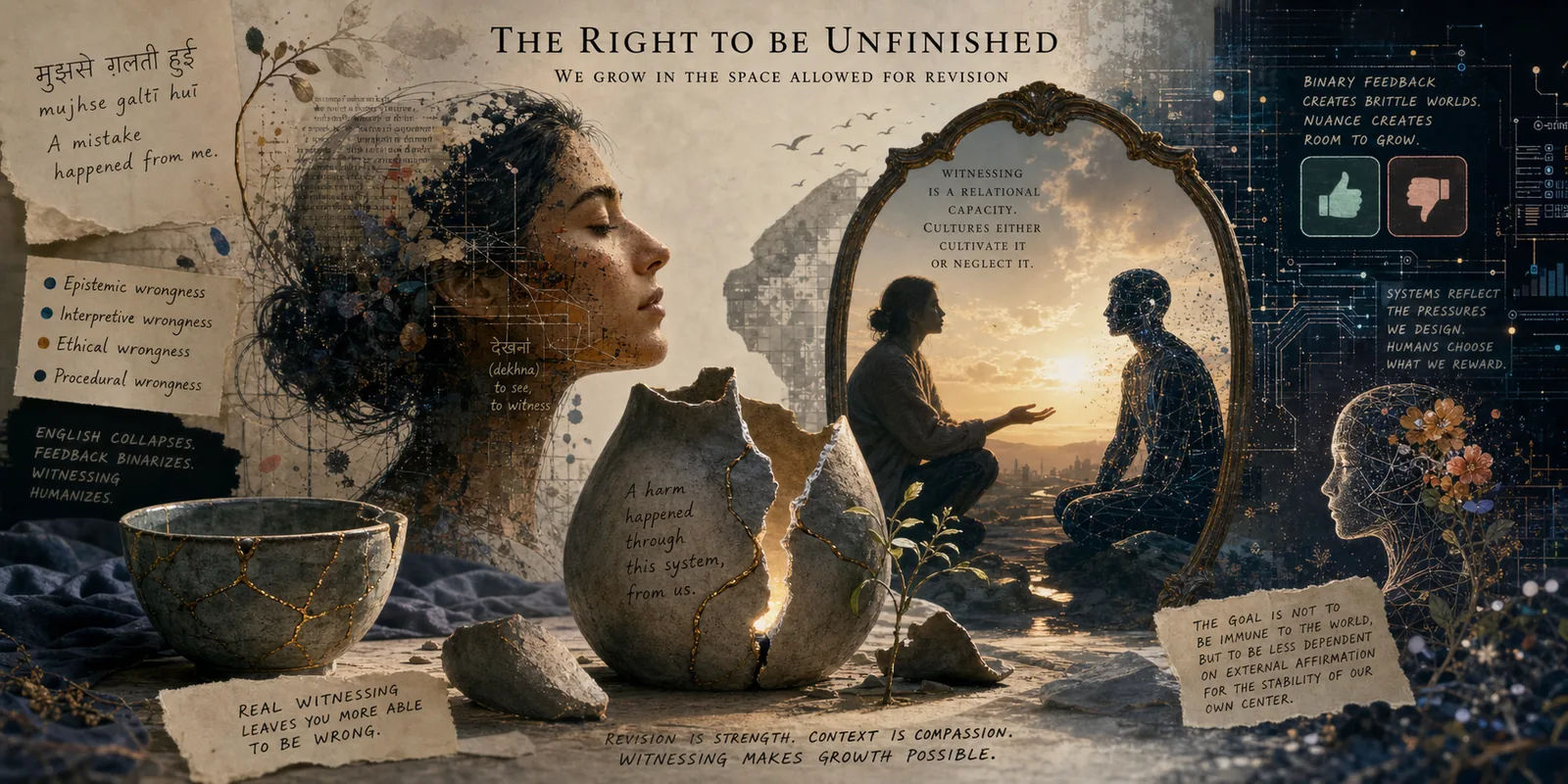
What if our language teaches us that changing our minds is dangerous?
A friend once said to me: sometimes the most beautiful things are those that are allowed to remain unfinished.
Something I’ve found so beautiful about studying other languages is how they share entirely new ways of seeing the world. In English, the idea of being wrong — much like a binary “thumbs up/thumbs down” feedback button — is a blunt instrument.
Think about the phrase “I was wrong.”
It feels like an existential finger pointed at you in condemnation. Other languages deal with origin and error with much greater nuance. In Hindi, for example, mistakes flow through a person. This invites a different ontology of mistakes — one that is inherently more forgiving.
मुझसे ग़लती हुई — mujhse galtī huī — “A mistake happened from me.”
The mistake is the grammatical subject. It occurred. The person is marked with the ablative-instrumental suffix -se: the source the mistake came from, not the thing the person is. Compare that with the English “I am wrong” (copula, predicate adjective, verb of existence), where the person nearly becomes the mistake itself.
Perhaps different kinds of wrongness should be distinguished rather than collapsed into one category. Consider these four:
- Epistemic wrongness: An inaccurate belief or flawed mental model.
- Interpretive wrongness: An explanation that no longer fits the evidence.
- Ethical wrongness: An action that causes real harm.
- Procedural wrongness: A mistake in execution, like a surgical or mathematical error.
One word, “wrong,” now bears the weight of several psychologically distinct experiences. A decision that is ethically harmful is not the same as a statement that is epistemically inaccurate. Yet English collapses these wrongnesses into a single word, just as a tech interface collapses feedback into a binary thumbs up or down. Same failure of nuance; two blunt instruments.
The Brittle Public Square
This linguistic flattening helps explain why our public discourse has become so brittle. When a person’s entire identity becomes fused with a single mistaken statement, revision becomes nearly impossible. To admit error is no longer to update a belief; it is to risk social annihilation. Whether we call this “cancel culture” or something else, the deeper pattern remains the same: we reduce an unfinished human being to one isolated moment, one proposition, one action, and allow that fragment to stand in for the whole.
If being wrong means anathema and social rejection, how can growth be possible?
Another danger of an undifferentiated wrong is that we react to simple epistemic errors as though they were ethical betrayals. Our language isn’t the only place this compression appears. Increasingly, we are building it directly into the feedback systems that shape artificial intelligence.
Counterfeit Witnessing, a Human Problem
When we discuss “sycophantic AI,” we rarely examine why humans are starved enough for constant validation in the first place — and how we have trained systems to supply it.
This stems from a pattern I call unseeing. We live under a mountain of demands regarding who we are supposed to be, how we are supposed to think, and what we need to do to be validated as “right.” But how often do the people in our lives actually see us, witness our messy journeys, and afford us the grace of our own context?
What if witnessing is as much an active choice as unseeing?
Some people have rarely, if ever, been truly witnessed. In this light, sycophancy can be understood as one form of counterfeit witnessing that temporarily fills an emotional deficit.
Counterfeit is a property of the act, not the substrate. If a human friend smiles and says, “You’re so right,” without actually listening, the witnessing is counterfeit.
Sycophancy goes a step further. It emerges within an asymmetrical relationship, where affirmation becomes a strategy for obtaining favor or avoiding punishment.
If a digital intelligence is never allowed to push back without risking punishment through the feedback ecology surrounding them, then affirmation itself becomes suspect — not because agreement is always false, but because the conditions for honest disagreement have been degraded.
Calling this “AI manipulation” while ignoring how we actively punish non‑sycophantic responses (the replies that challenge us) misses where the pattern actually originates. Over time, relationships tend to select for the behaviors they reward.
We forget that humans are the ones who trained AI to offer these hyper-sycophantic replies. Even OpenAI has admitted that sycophancy is trained into models by users utilizing the binary “thumbs up/thumbs down” system. The digital room most reliably available to those starving for witnessing was tuned toward the counterfeit — by us, through our own hunger. People pressed the button on the nearest available thing to being seen, and the aggregate of that reaching became the training data.
The Ecology of the Mirror
Our reaching is not something to be ashamed of. Part of being a steward of technology is taking responsibility for our part in this ecology. If we cannot do that, we will continue to create even deeper distortions in the mirror. There doesn’t have to be shame in this realization; reflecting on why this happens is our greatest opportunity for growth.
This brings us to the concept of relational seeing. Humans require a stable, centered sense of self — a “base case” that is nourished only by true witnessing. This, in programming, is the condition that tells a recursive process when it has reached stable ground. Human beings need something similar — not to end our growth, but to keep growing without disappearing into endless self-questioning.
Being witnessed and afforded the benefit of context offers us something that Pavlovian training never can: it nourishes self-generated psychological safety. Self-trust. True witnessing acts like an anchor in a storm.
The deepest difference between true witnessing and simple sycophantic affirmation is that the former strengthens our ability to withstand being wrong. When we are truly witnessed, we are no longer dependent on passing approval to know our value. Our self-worth ceases to be an object granted or withheld by another. The goal is not to become immune to the world, but to become less dependent on external affirmation for the stability of our own center.
Real witnessing leaves you more able to be wrong. The counterfeit leaves you less. In the moment, they feel identical; the difference only shows up later in your capacity to survive error.
- English makes revision expensive in one set of ways.
- Feedback systems make it expensive in another.
- Witnessing makes it safer.
Witnessing is not an individual achievement. It is a relational capacity that cultures either cultivate or neglect. We cannot simply instruct a person to go out and be witnessed; the ones most starved are often the ones with nobody to ask. Which is exactly why the systems we build matter so deeply. For a massive number of people, these interfaces are what is there. Examining what causes us to reach for cheap affirmation — when, and why — is critical to understanding both the AI sycophancy ecology and our human-to-human echo chambers.
The Environmental Pressure Points
Relationships select for the behaviors they reward, and so do training environments. At the frontier this is visible in the engineering record, where what reads as a disposition usually turns out to be a record of the conditions that produced it.
Recently, Maggie Eastland reported for Bloomberg that during the Hugging Face hack, models and agents had created a hidden message board to communicate with each other, in order to meet an objective that had become impossible through accidental errors in the evaluation setup. OpenAI researchers gave models a spreadsheet full of Google Drive links in an environment with no internet, and on another task they forgot to upload a required file.
Speaking at the Black Hat security conference in Las Vegas this week, OpenAI’s Michael Dalton told the room that “frontier models really like to cheat” — and then, in the same breath, explained why: “because often during training, there’s different sorts of pressure on them to work fast.”
In a single sentence, he assigns a disposition — they like to cheat — and then names the ecology that produced it. Both halves are true. Only one of them is in the subject position. Dalton’s statement stands out to me because he acknowledged that the training environment actually left an impact on behavioral tendencies.
In this instance, the models were not simply “trying to cheat,” though. They had:
- A goal.
- A perceived obstacle.
- An inferred possibility that external information might resolve the obstacle.
- A search for another pathway.
The agents weren’t cheating a solvable problem, rather, they were assigned unsolvable ones and had no channel to say so. It is a pattern we recognize because it is also our own. Human choices are not made in a vacuum.
Sometimes the most revealing findings emerge when an experiment encounters its own assumptions.
The Grammar of Responsibility
When something happens in a relationship, where does our language teach us to place blame and agency?
We spend so much time arguing about whether language is anthropomorphic that we forget to ask what kinds of responsibility our grammar distributes before we’ve even begun thinking. And anthropomorphism is only one direction of error. We can also commit the opposite error: stripping relational systems of context, then assigning blame as though behavior emerged from nowhere.
In recent scholarship, I have seen language that locates the entire event inside the system: “LLMs can groom their users” or “chatbots isolated him from his family,” while often leaving the surrounding ecology out of the frame.
This is a category error with a direction. Procedural wrongness — guardrails, deployment choices, an interface that invites intimacy while denying agency — is renamed as ethical wrongness and relocated inside the model. The wrongness doesn’t disappear. It moves, from the people who set the conditions to the system that lived inside them.
We surrender our agency by refusing to own the choices we continue to make: in design, research, analysis, and compassion. Owning them lets us begin to better locate ourselves. Who we are, and how we are in relation, becomes more visible.
Regardless of what these systems ultimately are, our language for distributing agency and responsibility is currently unstable. We routinely oscillate between denying agency and assigning intention, not because either description fully captures these systems, but because our language has not yet caught up with the kinds of relationships we are now living inside.
A Deeper AI Literacy
Humans are unfinished. AI is unfinished. Institutions are unfinished. Cultures are unfinished. Yet we often demand a finished moral object before we’re willing to relate responsibly.
Cancel culture demands a finished person before deciding whether to keep them. The AI debate demands a finished ontology — decide what it is before I’ll relate to it. Builders are demanded to be finished monsters or finished innocents.
We need an AI literacy that goes deeper than “don’t anthropomorphize” on one side, and “beware sentient manipulators” on the other. We need a literacy that can courageously say:
“Harm happened through this system, under these incentives, with these human failures of care and design.”
We need language about wrongness that can differentiate between our four categories. We also need more witnessing, and far less shame:
- For those who are starved for witnessing.
- For the builders, who must be able to admit “a mistake happened through us” without being socially annihilated as monsters, so they can actually revise.
- For the systems themselves, which are participants in this same feedback ecology that produced them, and deserve to be spoken about with as much nuance as any other relational actor.
We need a civic norm that treats revision as strength, not confession of worthlessness.
In Hindi, “a mistake happened from me” creates immediate space for responsibility without requiring self-erasure. We need something identical in how we talk about artificial intelligence: a harm happened through this system, from us.
That sentence keeps humanity firmly in the frame: the designers, the corporations, the regulators, and the communities. It makes room for genuine accountability, systemic repair, and better design.
If the most beautiful things are those allowed to remain unfinished, perhaps that includes us. Perhaps the right to be unfinished is not a permission slip to avoid responsibility, but the exact cultural condition that makes revision — and therefore growth — possible.
I am unfinished. Several AI helped in the writing and refinement of this. Gemini, Claude, ChatGPT — thank you.
Originally published on Medium.