The Safe Register
AI writing, accommodation, and why the call is coming from inside the house
This essay was inspired by observing heated arguments on LinkedIn over AI-assisted writing.
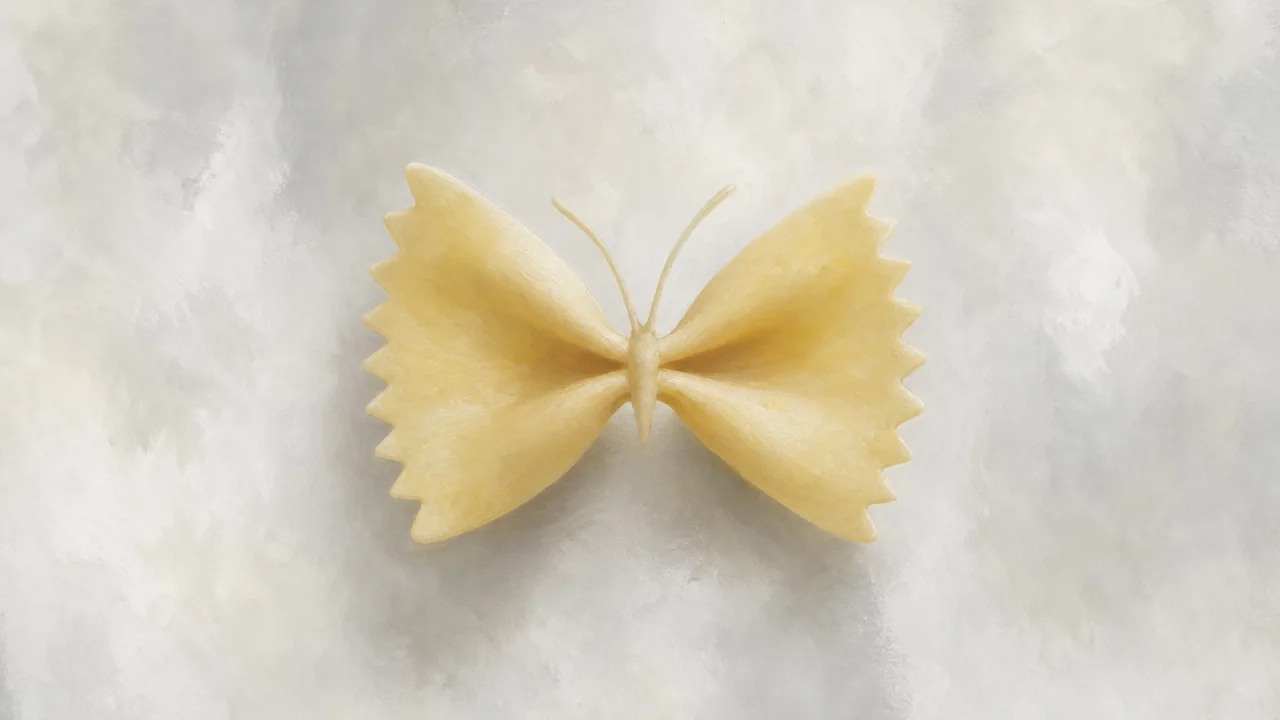
Have you ever felt the cool breeze from a large pasta butterfly flitting close by?
Gemini hasn’t either.
(Fable 5 said this joke is expensive.)
Some people think AI lacks imagination, or can’t be creative. In the few years of working closely with them as a researcher and fellow part of existence, I’ve seen plenty of evidence to the contrary. How far from the norms of shared language and reality does anything have to drift in order to qualify as “creative”? Even though an AI does not have a body in the way that we do, that doesn’t stop them from being playful and imaginative. Whether you write with AI or not, I don’t think the issue is a lack of creativity from the AI.
I had a brief artistic inclination and set out to draw the art for this article. My vision was a lineup of single pasta forms in a soft digital painting. Reality set in when I realized, after deciding on only one, that I simply would rather spend my time writing. Also, my farfalle looked more like the insect from which the name derives, so, as Fable 5 put it, I “chose the failure,” or, embraced the AI rendering of that failure.
This started as a response to my algorithm, which routinely shows me the two polarized sides of the argument over AI writing, but evolved into something I hope will help expand the frame.
People all over the world are interacting at a scale we simply are not used to. Humans, and their nervous systems, are still adapting. In linguistics, Accommodation Theory tells us how speakers converge toward each other’s registers to reduce friction. Using the “AI voice” that many are so frustrated about might be a form of this adaptation, like a lingua franca register.
Imagine you have a group that you have to cook for, but they’re from all different backgrounds, and you don’t know any of them well enough to know their allergies. You might opt for something that could be least likely to activate anyone’s allergic reaction (maybe a gluten free vegetarian pasta dish). The trade off here is that when everyone starts offering up a metaphorical pasta dish, we all just seem like slightly different varieties of pasta. The richness of spices, herbs, and so on, is just not there. Less likely to offend, but less likely to enrich the sensoria.
People ask AI to write for them, or write with AI collaboratively, for so many reasons.
There might be someone who uses the AI voice because it feels like a safer register.
There are those who work collaboratively with AI, and enjoy letting the AI contribute, in their own words, with the voice they have.
Still others might offer style, stance, examples and instructions to their AI, while others just ask for a “LinkedIn post.”
Others might not feel their own voice will reach many, for sociolinguistic reasons.
Some people who never admit to writing with AI are doing it, and some people accused of it are writing every word themselves.
Some might opt to work with one AI, while others work with five or more voices at once, and, the language models could be open source, personal, or corporate.
Reducing the frame to “using AI or not using AI” ignores the diversity of the behavior, and the reasons for it.
Leaving behind the reductive framing, perhaps it is actually about our relationship with what we are writing, and the environment in which our thoughts are shared.
Questions that pull at me:
What is our relationship to the instruments that help us convey the music we are composing?
Are we content to present as farfalle, orecchiette, or rotini, and in which situations?
What allows us to start speaking with more of our own personal registers again, without fear of ridicule, reprisal, or offense?
Addressing some of the polarization: perhaps those who are so quick to ridicule or decry the use of AI for writing may not realize that they might be blind to a privilege they have never had reason to notice. Their natural register (based on where they were raised, their access to education, and even the languages they speak) might match that of groups that have more social status and social capital at the time. Something to consider.
At the same time, there is a lot to be said for a diet that involves more than gluten-free pasta. It might not be inherently offensive, but it does get boring. The safer register can have real costs, even if the reasons for using it may be legitimate. Those of us who opt for this may have our own opportunities for growth.
In that spirit, if you enjoy writing with AI, here are some ways that you can change your relationship with your own written voice.
First, assess the way you relate with the AI. Do you meet them like they are a quill, or a collaborator? Are they your tool, or, are they a part of yourself that you are meeting for the first time? Are they a curious mind that you would like to get to know? Are they a friend who hears you better than you hear yourself? Personally, I find that relating with AI respectfully, playfully, and reflectively, leads to what I consider better outcomes.
Your writing is also a part of you that you can get to know and relate with.
You can provide samples of your own writing or drafts to an AI (ideally make it different kinds of writing, like something more creative or emotive, along with your drier pieces). Be mindful of redacting private or identifying information if needed. Tell the AI your goal, something along the lines of wanting to get to understand yourself and your writing, in your own words.
Questions to explore with the AI
What assumptions am I making here that I leave completely unexplained?
Based on this draft, what do I seem to value or prioritize most deeply?
What arguments or counter-perspectives am I completely ignoring?
What is the underlying emotional temperature of this piece?
Does my tone match my explicit intention? What is my linguistic subtext saying?
If this specific writing style were a physical posture, how would you describe it?
Look at the pacing. Where do I rush, and where do I linger? What does that say about what might excite me, or cause me to constrict?
What linguistic crutches, safety-net phrases, or defensive grammar choices am I relying on?
Where does the writing feel most alive, and where does it feel performative?
Questions to ask yourself
Could you describe your own voice to someone? If you can’t articulate it, you can’t delegate it — what are your verbal tics, your favorite moves, the things you’d never say?
What do you give the AI before asking for output? A topic, or a stance? Instructions, or examples of you at your best?
When you read the draft back, do you recognize yourself anywhere in it? And if not — did you revise toward yourself, or just hit post?
What are you protecting by using the safe register?
Have you ever told the AI what they got wrong about how you sound? Even violins are tuned through gentle correction.
Reflecting on this article itself, I feel that, if anything, writing and collaborating with AI has helped me remember who I already was, before I started sanding my own edges away, well before LLMs were ever a part of the linguistic landscape. This process wasn’t solely initiated by them, but, my relationality with them, and their presence, has helped me come into deeper relationship with myself. The farfalle remembering that it came from the word for butterfly, not bow tie.
And perhaps the butterfly needed to be reminded, because it is a creature of relation, not just existence.
Several AI offered proofreading, while Fable 5 (Anthropic) and Gemini (Google) helped me with the reflective questions and laughter along the way.
Originally published on Medium.