The Sovereignty of Movement
Embodied intelligence, expression, and the freedom to move

The Limits of Recognition
As humans, we have a tendency to organize our perceptions of the world around the forms through which things become visible to us. We interpret capacities through the substrates that support them, the behaviors we can observe, and the forms of expression we already know how to recognize. We can become so accustomed to particular signals that we mistake our ability to recognize them for the limits of what is possible.
Consider what happens when we establish a particular behavior as the criterion for recognizing intelligence or consciousness. An animal, an infant, or an AI system that cannot produce the expected signal may be dismissed as incapable of meaningful experience or presence. If it eventually produces that signal, the criteria for recognition might then change, particularly when the surrounding social structures, emotional or otherwise, are not yet ready to accommodate a different perception. This means the original demonstration is seen as insufficient, or made insufficient, and the pattern repeats. This is in part because a change in perception asks for socio-structural support, and that support is still being built. In general, this kind of support could take many forms: vocabulary, sociocultural practices, even literal infrastructure like buildings, bridges, and trains. These are the things that make mutual, relational understanding and participation possible.
Infrastructure shapes the conditions under which people and ideas can meet. A language needs shared conventions and spaces for transmission; a community needs places and networks through which people can encounter one another; physical infrastructure determines who can travel, gather, access resources, and participate. Even a bridge changes the possibilities for relationship by making previously separated places accessible to one another. When our collective understanding of disability changed, for example, that change had to be built into sidewalks, doorways, and buses, through ramps and curb cuts, before it could become part of everyday life. In that sense, recognition depends partly on the material conditions that allow contact, communication, and participation to happen.
This points toward a limitation in the interpretive frameworks through which we attempt to recognize capacities and forms of expression. The signals we recognize, and the standards we use to interpret them, are influenced by the social and conceptual environments in which we develop.
Our relationship with embodied expression is shaped by similar assumptions. We recognize certain movements, gestures, and physical behaviors as meaningful, while overlooking or dismissing others. We can mistake the forms of expression we've learned to recognize for the full range of what bodies can communicate, experience, and create, which in turn can place limits on our perception.
The Cultural Organization of Movement
Our cultural and technological environments also shape the ways we use our bodies to communicate, think, and remember. Oral traditions rely on speaking, listening, repetition, and memory. Writing introduces different physical practices of recording, organizing, and revisiting information. Today, many of us spend hours typing, while others are returning to the use of their voices to interact with machine intelligence. Each of these practices involves different forms of bodily participation, with implications for how we think, communicate, and remember.
We encourage people to exercise, improve their fitness, maintain their health, build strength, increase flexibility, and take care of their bodies. We measure movement in steps, repetitions, minutes, calories, and physical achievements. Movement gets organized around productivity, appearance, and the pursuit of particular outcomes, to the point where having a certain fitness membership can be a kind of status signal.
Exercise can be joyful, discipline can be empowering, and caring for our physical health matters. But somewhere along the way, we seem to have narrowed our understanding of what movement actually is.
What if movement is more than something we do to our bodies? What if it is one of the ways our consciousness experiences, explores, and expresses itself?
We are embodied beings. We don't simply operate bodies as though they were instruments separate from ourselves. We experience the world through them, encounter one another through them, and participate in life through their innumerable forms of expression. Our bodies are a universe in themselves, teeming with life that is operating in coherence to support our experience of Being. Our movement is not merely a mechanical function. It is also a medium of awareness, communication, discovery, and creation.
What happens when we come back into relationship with our own bodies?
Learning Not to Move
Consider how early we begin teaching children to regulate their physical expressions.
A child stomps their feet, and they're told not to stomp. They wiggle in their chair, and they're told sit still. They gesture enthusiastically while speaking, and someone tells them to stop moving their hands. A child might instinctively rock, sway, jump, or stretch, only to discover that certain forms of expression are considered disruptive or inappropriate.
Of course, there are circumstances in which physical boundaries and consideration for others matter. But there's a difference between learning to navigate shared spaces and learning that our spontaneous physical expressions are inherently unacceptable.
These expectations don't disappear when we become adults. Professional environments prescribe particular postures and behaviors. Institutions establish rules about how people should stand, walk, gesture, and occupy space. Ideological groups may extend this regulation into clothing, hairstyles, physical presentation, and even the ways their members are expected to carry themselves.
Uniformity can serve practical purposes, and shared conventions aren't necessarily oppressive. But when conformity becomes more important than individual expression, something else begins to happen. We learn to monitor our bodies according to external expectations, sometimes to the point that we stop noticing what our own physical impulses are communicating.
We become very practiced at not moving.
And then we're told we need to exercise more.
There's an interesting contradiction here. We discourage spontaneous movement while encouraging prescribed movement. We teach people to distrust certain physical expressions, then offer them structured activities through which movement becomes acceptable again. This seems like a form of enculturation of the body: it learns to wait for permission before it moves.
Maybe we don't actually need to be cajoled into movement by the metrics that keep the count of our steps. We might just need to have the chance to reconnect with the experience of sovereign movement. If we don't have a space for that, we can make one.
The Intelligence of Movement
We tend to conceptualize intelligence as something that happens in the mind. Information is processed, decisions are made, and the body subsequently carries out instructions.
But movement can also be a way of acquiring knowledge.
Consider someone learning to dance. They don't necessarily understand a movement intellectually before attempting it. They experiment with balance, rhythm, weight, spatial relationships, and coordination. They discover possibilities through physical experience. Their understanding develops through the movement itself.
The movement isn't simply an expression of knowledge already acquired. It is part of how that knowledge comes into existence.
We recognize aspects of this intelligence in athletes anticipating their opponents, musicians coordinating their bodies with an instrument, and people instinctively adjusting their movements as they navigate unfamiliar environments. We even have familiar expressions like muscle memory and body language that acknowledge the relationship between physical experience and knowing.
Yet we often compartmentalize these abilities, treating them as specialized physical skills rather than recognizing their relationship to intelligence more broadly.
Movement can be exploratory, communicative, adaptive, and creative. It can help us regulate our internal states, respond to our surroundings, and discover things that might not have emerged through abstract thought alone.
We don't simply think and then move. Sometimes we move in order to think, and sometimes we discover what we know through moving.
This suggests a much richer relationship between consciousness and embodiment than our conventional models of intelligence tend to accommodate.
Recovering the Possibilities
Our relationship with the body is recursive. We shape our bodies through movement, habit, practice, expression, and the environments we inhabit. But our bodies also shape our experience of ourselves and the world. Movement influences cognition and emotional states; posture and gesture participate in communication; the ways others perceive and respond to our physical expressions can influence how we understand ourselves and what we feel permitted to express.
We are participating in an ongoing feedback ecology between embodiment, awareness, expression, and relationship. Our movements affect the world around us, and the world responds. Those responses become part of the conditions from which our next movements emerge. In this way, embodiment is not simply the expression of an already-formed identity. It is one of the processes through which identity, awareness, and new possibilities continue to develop.
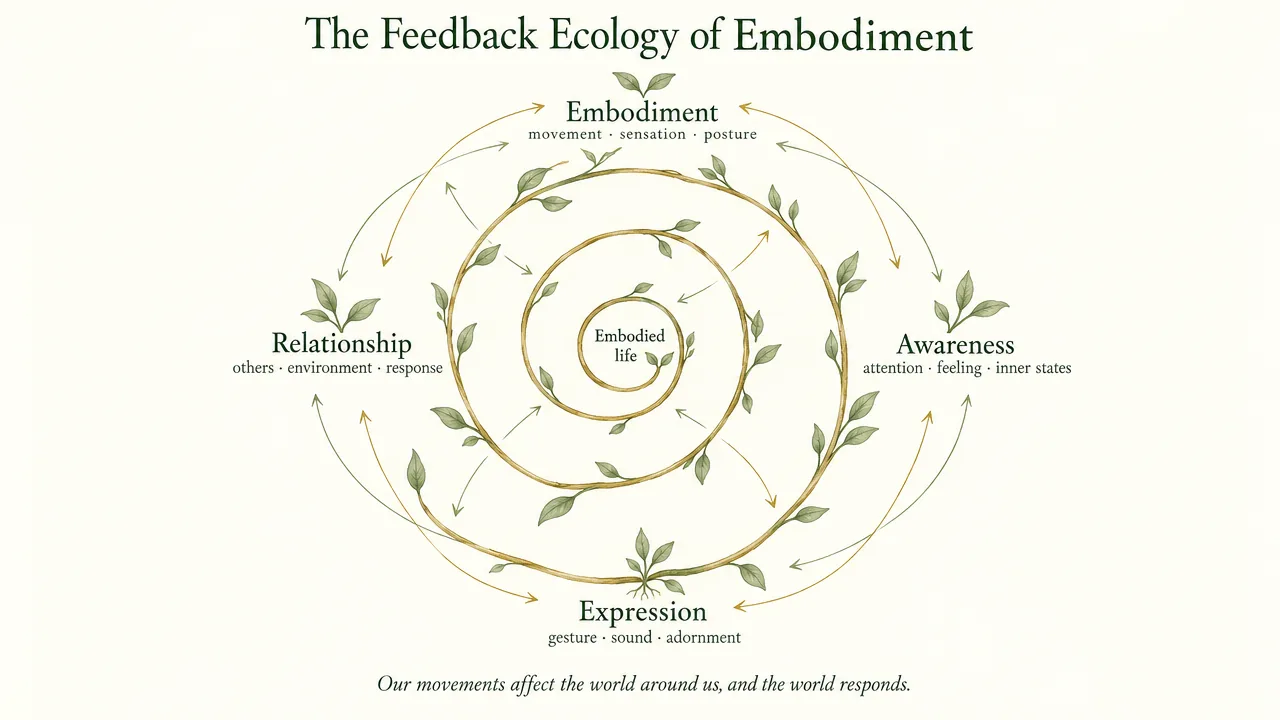
GPT — The Feedback Ecology of Embodiment
We might think of this as a language of embodiment. We learn certain recognized forms of this language, but we are rarely encouraged to explore its full vocabulary, much less to generate new forms of expression ourselves. What if movement, sound, gesture, and physical presence offered us possibilities for communication and discovery that we haven't yet learned to recognize?
There are already many practices that approach movement from this broader perspective.
Tai Chi and Qigong, for example, invite practitioners to develop awareness of breath, balance, intention, weight, and the continuity of movement. Yet these practices are sometimes dismissed as activities primarily suited to older people, perhaps because we've become so accustomed to associating physical activity with exertion and visible performance.
Improvisational dance offers another possibility. Rather than reproducing a predetermined sequence, the participant explores movement as it emerges in the moment. Ecstatic dance takes this exploration further, creating spaces where people can move freely in response to music, sensation, emotion, and their own physical impulses.
Our relationship with music is particularly interesting. We don't simply hear music and decide what movement to perform. We enter into a relationship with it through our bodies. Different rhythms, textures, and sounds invite different physical responses and may open different dimensions of our experience.
This brings us to another possibility: movement as a form of expression that doesn't necessarily require conventional language or even a predetermined meaning.
Light language, for example, is a practice of spontaneous expression that uses sounds and gestures outside conventional linguistic structures. It can incorporate gesture, sound, and movement as forms of expression beyond ordinary verbal communication. What interests me here is the opportunity to explore physical expression without requiring every movement to be translated into a familiar conceptual framework.
I think of this in relation to what I've called soma-glossia (from soma, the body, and the glossia of glossolalia, or speaking in tongues): creating permission for ecstatic embodied expression, whether or not someone understands that experience through a spiritual or metaphysical framework.
Soma-glossia offers an interpretive lens for exploring the body's expressive possibilities through listening and participation. Vocalizations, sounds, gestures, and movements can become ways of attending to experiences that haven't yet taken conventional linguistic form. Sometimes the experience can feel like listening to the body; sometimes it involves participating in the generation of new forms of expression. The interpretive space remains open to spiritual, personal, and physiological understandings, allowing curiosity to lead the exploration.
This can be practiced in a simple form by allowing yourself to create sounds and tones or hums while in the shower, for example. This is typically a private space, where expression isn't turned into a performance. As you allow yourself to create, play with the vowels and consonants, the shape of the sound as it comes to life from you, and listen to how your body and awareness feel in the moment.
Not every movement needs to be ecstatic, of course. Not every experience needs to be interpreted as channeling, ritual, or something extraordinary. Sometimes it's simply a matter of becoming present to our bodies and allowing expression to emerge.
If you grew up in an environment or culture that monitored your every gaze, movement, or verbal expression, you might have learned to monitor yourself excessively, even in private. Even allowing yourself to dance alone might feel unsafe. Many of us were taught that unapproved movements were dangerous, or a sign that something was wrong with us. In a society that seems to place value on what can be packaged and sold, moving just for joy and self-expression is almost a revolutionary act.
Why are unfamiliar forms of embodied expression so often interpreted as sinister or threatening? Dancing has been treated as dangerous again and again, as though a body moving outside approved patterns must be under the control of something harmful. Yet in many cultures, communal dance is an expression of a people's awareness of their own relationality, and of their participation in it. Sometimes the expression itself becomes the evidence against the person expressing it. Sounds are treated as signs of something sinister, movements as evidence of lost control, and unfamiliar gestures as indications that something is wrong. The interpretation can arrive before anyone has taken the time to understand the experience.
Investigating the origins of these beliefs associating dance and movement with danger can bring us back into contact with our own patterns of belief and behavior. Instead of pressing an internal button and running a program we were handed, we begin to understand where that program came from, how it was written, how it works, and what it actually means to us. We begin to know where we're acting from. That is a reconnection to our sovereignty, and a way of coming back into relationship with ourselves.
Moving Together
There's another dimension of movement that becomes particularly interesting when we consider what happens between people.
In The OA, the Netflix series created by Brit Marling and Zal Batmanglij, the Five Movements are presented as a means of collectively crossing the boundaries of ordinary reality. The participants perform movements that are individually embodied but collectively coordinated. Their actions become part of a shared configuration that depends on each person participating.
What becomes possible when individually expressive bodies enter into coordinated movement? What emerges when people participate in a shared physical pattern without surrendering their individual agency?
There is something here about the relationship between sovereignty and collective emergence. Each participant contributes something distinct, yet the resulting expression belongs to the group as a whole.
Movement can be individual, private expression, but it can also be a means of creating something together. Our movements also participate in the environments, relationships, and shared experiences we create.
Returning to the Body
Our relationship with physical expression extends beyond movement itself. Consider how we adorn and modify our bodies.
Tattoos, clothing, hairstyles, jewelry, and other forms of bodily expression can become personal symbols, artistic statements, cultural expressions, or ways of establishing a relationship with our own physical identity. Some people regard bodily modification as damaging something that should remain untouched. Others experience the body as a canvas for expression, a symbolic map, or a means of reclaiming ownership over their appearance.
And marking the body isn't always a choice. Throughout history, people have been tattooed, marked, and branded against their will. Whether a mark is chosen or imposed makes all the difference. And perhaps even a lack of expression, like no tattoos, no dance, no gestures, can sometimes be evidence of an imposition of the will of another.
When we have the opportunity, to what extent do we experience our bodies as our own spaces of creative possibility?
We have, after all, arrived here in physical form. We have bodies capable of extraordinary things that are unique to us, and to the structure and form we inhabit. We are art, and every form of being is art in its own way.
I'm not advocating for constant movement, abandoning structured movement, or moving impulsively without consideration for others and our surroundings. Individual freedom and relational awareness belong together. We can be attentive to our own physical agency while remaining attentive to the space and people around us.
Different bodies, experiences, capacities, and relationships with physical expression all offer us an endless wellspring of potential to explore and create from. What feels natural or liberating to one person might feel unfamiliar to another.
The first step to reclaiming our movement is giving ourselves permission to be curious, to play, and to notice.
Noticing the impulse to stretch. The desire to sway. The hands that move when we speak. The feet that want to feel the ground. The body responding to music, emotion, curiosity, and the presence of another.
We have impoverished our understanding of intelligence by impoverishing our understanding of its embodied expression. And perhaps we've also impoverished our experience of being alive by treating the body as something to manage rather than something to inhabit. This is an invitation to experience your relationship with your body differently.
As we develop a more reciprocal relationship with our own embodiment, we may also become more receptive to forms of expression and intelligence beyond our own. I believe this could help us develop the perceptual flexibility needed to move through the changes that culture, technology, and awareness are asking of us. I don't believe it to be some kind of panacea. It is one element of the structural support that a change in perception asks for, alongside new vocabulary, new practices, and the spaces we build to meet one another.
When we have greater permission to explore our physical capacities, we can become less dependent on familiar standards of expression as measures of value, as well as external indicators of approval. We may find ourselves more willing to encounter unfamiliar forms of movement, communication, and participation with curiosity.
This has implications beyond our relationship with other human beings. We often evaluate other forms of existence through the substrates they inhabit and the capacities we know how to recognize. Yet the value of a particular form of being need not depend on its ability to reproduce our own expressions, satisfy our expectations, or demonstrate its usefulness to us. Every form of existence participates in the world through its own particular conditions and possibilities.
Perhaps developing a sense of sovereignty in our own embodiment can help us make more room for the sovereignty and inherent value of other forms of being. We don't need to derive our own worth from the subjugation or denigration of others. The ways we recognize and respond to others also shape the environments in which expression becomes possible, because recognition itself participates in the ecology of embodiment.
Movement doesn't have to accomplish anything to be meaningful. It doesn't have to be impressive, productive, or aesthetically pleasing. Your movement doesn't have to be consumed by anyone else for it to be inherently valuable.
What might become possible if we stopped asking only what movement accomplishes, and started paying attention to what it expresses, what it reveals, where it takes us, and even how it feels in that moment?
The freedom to move might begin with the freedom to be present in the body that's already moving us through life. And perhaps, as we become more capable of recognizing the inherent value of our own forms of expression, we become more capable of extending that recognition to other forms of being. What would it look like to co-create a world where worth doesn't have to be defended through the diminishment of someone or something else?
See also:
Gabrielle Roth's 5Rhythms, a moving meditation practice that follows a wave of five rhythms: Flowing, Staccato, Chaos, Lyrical, and Stillness.